Showing posts with label Donald Trump. Show all posts

Saturday, January 27, 2018

TRUMP'S CLIMATE ARGUMENT SHIFTS FROM SCIENCE TO ECONOMICS

COURTESY PICKABAY


By Anne Zeiser
Founder of Azure Media 
Author of  Transmedia Marketing: From Film and TV to Games and Digital Media


The semantics of climate change have evolved from global warming to climate change over the last 25 years, but have focused on the science. This week, Donald Trump pulled the U.S. out of the historic Paris Climate Agreement, in which 194 countries pledged to step up their commitment to cutting carbon emissions. In his announcement, Trump reframed the discussion away from the science of fossil fuel’s effect on the environment toward economics:
“The Paris climate accord disadvantages the United States, to the exclusive benefit of other countries, leaving American workers, who I love, and taxpayers to absorb the cost in terms of lost jobs, lower wages, shuttered factories and vastly diminished economic production.”
Trump’s always planned on pulling out of the Paris accord because he’s a self-proclaimed America Firster; he’s cozy with the petroleum industry; and he thinks whatever Obama did is inherently bad. He chose an economic argument because he thought his background as a businessman would bestow unquestioned credibility upon him. Plus, his fake science and conspiracy theories might no longer fly.
But Trump’s economic argument for why it’s OK to sully the Earth and jeopardize our future is just as specious as his climate science reasoning, fixing him as the “laughing stock” of the world. Once again, Trump’s hubris has backfired: the science and environmental reality of climate change won’t go away; his fact-free economic reasoning is easily shredded; and pulling out of the Paris Agreement is wildly unpopular. The accord is supported by almost 70 percent of Americans, every major global economy, and scores of major U.S. and multinational corporations.
Trump’s alienated himself and the U.S. from most of the world by making a morally bereft and financially short-sighted decision about climate. But he’s made a fool of himself by making assertions about climate change based on Bad Science and Bad Economics, which simply don’t add up to sound arguments.
Bad Science
Trump has a legacy of misunderstanding and spewing bad science about climate change. He ignores decades of peer-reviewed scientific studies on global warming that predicted the climate change that’s happened. And he dismisses the current science on the state of the planet and future effects. Like fossil fuel advocates who push out misinformation andpeople who don’t understand climate science (Trump is both), Trump confuses weather and climate to try to disprove climate science:
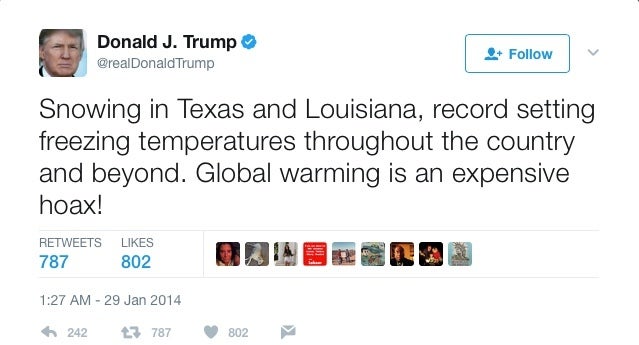

Of course, weather is the short-term natural variations in temperature, clouds, precipitation, humidity and wind in a region and climate is the long-term average of those characteristics in a region. Meteorologists summarize it as, “Climate is what you expect; weather is what you get.” So, a snowstorm in the southern U.S. is a normal weather fluctuation and doesn’t disprove the growing trend of climate change. 
Trump regularly misstates the scientific facts, here suggesting the ice isn’t melting in the Arctic and Antarctic:
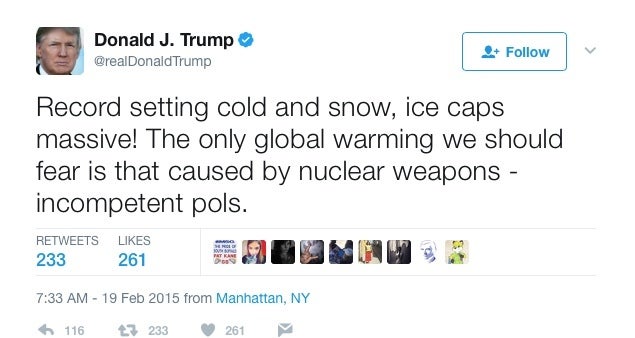
Ironically, the vast oil reserves beneath the Arctic are now drillable because global warming has melted the Arctic ice enough to reach them. In the many decades Big Oil was denying global warming, it was secretly preparing Arctic operations to reap huge profits from it. In 2012, Exxon Mobil’s former CEO, and current Secretary of State, Rex Tillerson forged a symbiotic relationship with Vladimir Putin to commence those operations. Trump’s stance on climate is reflected by his cabinet picks of four fossil fuel supporters from Texas and Oklahoma. It also may explain his bromance with Putin. Perhaps Trump’s shift in his anti-climate change argument from science to economics hints at his true agenda – personal economics.
In his Paris Agreement speech, Trump misstates the science again to suggest the global pledges wouldn’t have a significant effect:
“Even if the Paris Agreement were implemented in full, with total compliance from all nations, it is estimated it would only produce a two-tenths of one degree Celsius reduction in global temperature by the year 2100. Tiny, tiny amount.” 
The MIT scientists who published the April 2016 study Trump cited, actually reported that global warming would slow by between 0.6 degree and 1.1 degrees Celsius by 2100. That’s huge when the overall goal is two degrees Celsius above pre-industrial levels. 
When in doubt, Trump throws out inexplicable conspiracy theories, which appeal to the irrational. Here he blames the hoax of climate change on China:
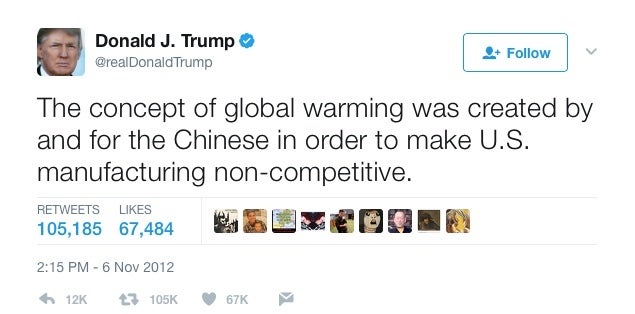
All this adds up to Trump’s penchant for science fiction ― fueled by his lack of understanding of the scientific process and his unfettered pursuit of political and personal gain.
Bad Economics
Trump’s financial and jobs arguments aren’t any better. In his Rose Garden climate accord speech he relies on hyperbole, saying the Paris climate accord imposes “draconian financial and economic burdens” on the U.S.
If that were so, why would the U.S.’s economic leaders – from tech, Google, Apple, Microsoft, Twitter, Facebook, Intel, Hewlett Packard, and Adobe; manufacturing and infrastructure, GE, Johnson Controls, Ingersoll Rand; consumer products, Procter & Gamble, Unilever, Coca-Cola, Tiffany, Levi Strauss, Mars, The Gap; financial services, Goldman Sachs, Morgan Stanley, The Hartford; automobile, Tesla, General Motors; and even fossil fuels, Royal Dutch Shell, ExxonMobil and BP – all support the Paris Climate Agreement? None of these companies wants to be “hamstrung” or penalized.
In fact, 25 big companies placed full-page ads in major U.S. media outlets to urge Trump to stay in the pact. In their plea to stay in, they cite key economic reasons that obliterate Trump’s claims:
  • Strengthening Competitiveness: By requiring action by developed and developing countries alike, the agreement ensures a more balanced global effort, reducing the risk of competitive imbalances for U.S. companies.
  • Creating Jobs, Markets and Growth: By expanding markets for innovative clean technologies, the agreement generates jobs and economic growth. U.S. companies are well positioned to lead in these markets. Withdrawing from the agreement will limit our access to them and could expose us to retaliatory measures.
  • Reducing Business Risks: By strengthening global action over time, the agreement will reduce future climate impacts, including damage to business facilities and operations, declining agricultural productivity and water supplies, and disruption of global supply chains.
To make his assertions, Trump cherrypicks proof points without presenting the full picture. He says, “Compliance with the terms of the Paris accord ... could cost Americans as much as 2.7 million lost jobs by 2025.” Referring to fossil fuel-associated industries, he further calls out his poster child, the obsolete coal industry, yet ignores the economics of the burgeoning renewables energy industry.
His math is simply inaccurate. According to a new report by the U. S. Department of Energy, solar power alone currently employs almost twice as many in the U.S. as coal, natural gas, and oil and petroleum combined. Adding wind and nuclear, clean energy outpaces traditional fossil energy jobs by almost three-fold. Advanced energy – seven business sectors committed to clean energy – employs 3.3 million in the U.S., while coal mining employs about 86,000.
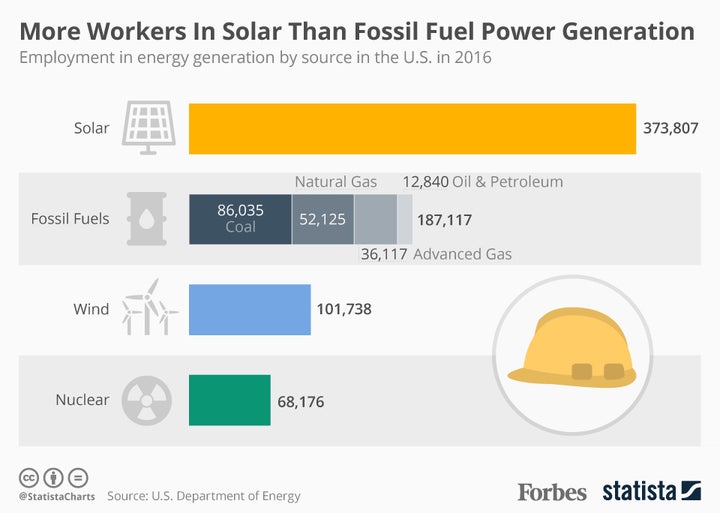

Advanced energy is one of the most vibrant global industries, generating $1.4 trillion in global revenue last year, “nearly twice the size of the airline industry, equal to apparel, and close to global spending on media, from newspapers to movies to video games,” according to Navigant research. And it’s growing twice as fast as the overall economy (7 percent vs. 3.1 percent). An International Renewable Energy Agency report predicts that global renewable energy will nearly triple employment by 2030 to 24 million jobs. If unfounded dire economic predictions aren’t enough, Trump heightens fear or anger towards perceived enemies. He suggests that China and India aren’t being held to the same standards as we are:
“China will be allowed to build hundreds of additional coal plants. So we can’t build the plants but they can. According to this agreement, India will be allowed to double its coal production by 2020. Think of it. India can double their coal production. We’re supposed to get rid of ours.”
Context matters. China and India are behind the rest of the developed world in having access to cleaner technologies, but are working at lowering their emissions at breakneck speed. To catch up, China’s now building a new green power infrastructure as big as the U.S.’s entire electric grid. China’s also pledged $3.1 billion in aid to the U.N. Green Climate Fund to help climate-vulnerable countries (now, the U.S. won’t honor most of its $3 billion pledge). China’s already shown exceptional climate and clean energy global leadership and is poised to fill the big void that Trump created by pulling the U.S. out of the accord. India plans to source 40 percent of its energy from renewables by 2030, passing Japan as the third largest solar market behind China and the U.S. 
Finally, Trump resorts to blatant scare tactics. He says the U.S. “will be at grave risk of brownouts and blackouts.” Two of the country’s biggest providers of electricity to industries and consumers, National Grid and Schneider Electric, support the Paris Climate Agreement. They understand that using combined energy sources during the transition will prevent against blackouts. 
All this adds up to fuzzy math and “Trumped up” economics fueled by Trump’s fear of innovation and his patent disregard of the future. It’s as if he’s advocating for the long-term future of the manual typewriter while the personal computer is flourishing and demonstrating its promise. 
During his Paris climate accord announcement, Trump asks, “At what point do they start laughing at us as a country?” If not at previous inflection points, surely it was the moment Trump pulled out of the Paris Climate Agreement. France’s President, Emmanuel Macron captured the world’s sentiment with his slogan, “Make The Planet Great Again!”

_________________________________________________________________
Anne Zeiser is a critically acclaimed transmedia and social impact producer and media strategist. She’s stewarded films and iconic series for PBS, produced news for CBS, managed national brands for marketing firms, and founded Azure Media, which develops transmedia projects on air, online, and on the go that fuel social impact in communities, in schools, and in capitals. She’s the author of Transmedia Marketing: From Film and TV to Games and Digital Media, from Focal Press’ American Film Market® Presents book series.
Follow Anne Zeiser on Twitter at @AzureMedia

This article originally appeared in the Huffington Post

Monday, November 14, 2016

5 THINGS TRUMP'S WIN TAUGHT MY 12-YEAR-OLD SON

TomWang112


By Anne Zeiser
Founder of Azure Media 
Author of  Transmedia Marketing: From Film and TV to Games and Digital Media


My son’s middle school pre-election vote was prescient. Donald Trump beat Hillary Clinton by 7%. “Could this actually happen in real life?,” asked my 12- year-old. “Yes it could.” For more than a year, I have predicted that this outcome was likely. Ask my friends and family about the heated discussions at cookouts and holiday get-togethers. Most dismissed my theory that Trump would win because of the hidden, growing trend he represented and pandered to. I suspected the polls wouldn’t fully reveal this partially underground phenomenon. 

Now that it has come to pass, what to say to a kid who heard Trump’s “build a wall” statement in real time and called him on it vehemently? A kid who formed his own opinion of who was the better candidate, landing firmly on Hillary Clinton. So, when Trump became the President-elect, what could he learn from the loss of his chosen candidate?


These are my suggested takeaways:

1. Life isn’t fair. It never has been and it never will be. The sooner and the more deeply you learn this, the better-equipped you will be to handle life. “So what?” if a kid stole your ball, the teacher blamed you for something you didn’t do, a colleague presented your idea as his, or your candidate didn’t win? The takeaway: Decide how you are you going to handle it. Are you going to blame your current circumstances on external forces?  Are you going to dwell on the fact that it’s unjust? Or, are you going to translate that ire into resolve to do something about it… starting now? 
2. Find the good in people. Are all of Trump’s supporters, bigots, misogynists, and haters? Probably not. But they’re all scared. They’re afraid of losing something precious — their economic or social standing. We know how swiftly fear brings out the worst in people. We saw the rise of fear in Nazi Europe and we saw FDR brilliantly allay it when the Great Depression descended upon this country. The takeaway: Work hard to understand what people are afraid of. Is it fear of lost jobs, diminished quality of life, or “otherness?” Once fear’s understood, you can combat it – by demonstrating how rising tides raise all boats or how we all share a common human experience. 
3. Understand that you have power.  Whether you’re a 12- or 87-year-old; a business owner or unemployed; a white male or a member of a disenfranchised group; you are powerful, especially in this country. You have rights. You have a voice. You have platforms. You have agency.  The takeaway: Every person’s actions matter. The greatest movements began with one person who inspired others to stand up for good. What you do in your life – no matter how seemingly insignificant – has a ripple effect on the people around you, and so on, and so on. Gather up your power and feel its strength.
4. Identify clearly what needs fixing. While there’s a lot to do to make the world a better place and it’s great to feel passionate about many things, you can’t fuel real change without identifying concrete problems and solutions.  What will ensure all Americans have equal rights under the law? How do we give everyone an opportunity to prosper? What measures will protect our planet from climate change? The takeaway: Find your cause(s) and identify the various ways to improve it. Some solutions involve top-down institutional or policy change. Others use bottom-up grassroots public pressure. Most use both. What elements of those solutions can you truly advance?  
5. Create a practical action plan.  Actions affect change. Your actions should be proportional to the concern you feel. If you think the long-standing future of the country is at stake, then make a long-standing commitment to getting involved. Progress requires hard, protracted work. You can sign a petition or post on social media, but will armchair activism be enough? The takeaway: Evaluate the most effective ways you can make a difference. Are you a strong writer or a tech guru? Can you lend your skills to like-minded people or groups? Perhaps you will shape your career to positively impact this world. Will you run for office? Invent something useful? Advocate for the needy?
In seeking lessons around the outcome of the recent election for my 12-year-old – a person old enough to understand what’s going on in the world, but not old enough to fully feel his agency in changing it – I learned a lot. Proof positive that parenting often teaches us more than we teach our children.  In that spirit I share what I hoped my son would learn during this exceptional time – a time that’s raw, but rife with opportunity.

This updated story also appeared in the HuffingtonPost.

_____________________________________________________________________

Anne Zeiser is a critically-acclaimed transmedia and social impact producer and media strategist. She's stewarded films and iconic series for PBS, produced news for CBS, managed national brands for marketing firms, and founded Azure Media, which develops transmedia projects on air, online, and on the go that fuel social impact in communities, in schools, and in capitals. With media partners from PBS and the BBC to Miramax and Sikelia Productions, Zeiser has successfully launched and marketed film studios and media organizations, feature and documentary films, television series and specials, mobile games and apps, and online video and media communities. She's the author of Transmedia Marketing: From Film and TV to Games and Digital Media from Focal Press' American Film Market® Presents book series. You can follow her at the book’s Web site or on Twitter @azuremedia.

Monday, August 1, 2016

REVEALING THE TRUE PERSONA OF THE NEXT PRESIDENT

Add caption


By Anne Zeiser
Founder of Azure Media 
Author of Transmedia Marketing: From Film and TV to Games and Digital Media


Social media has made everyone a brand and everyone a brander. Do you register on your social graph as snarky or heartwarming? What reflects you better, driving a Jeep or a BMW? Audiences have an innate understanding that a brand's public expressions, the company it keeps, and what others say about it imbue it with characteristics and attributes.

Presidential candidates are the ultimate American brands. In pre-literate eras, their brands were expressed through cartoons and posters. They've since evolved to campaign buttons, brochures, ads, logos, taglines, and theme songs. Like all brands, candidates reflect a coherent set of concepts that are the sum of:
  • Identity - what they stand for
  • Image - what they represent
  • Aspiration - how they make audiences feel


BRAND DISCOVERY THROUGH ARCHETYPES

To understand a brand's essence you must find its true brand personality or persona. A simple, intuitive, and clarifying construct to reveal personas taps the long-standing storytelling character device - the archetype. Archetypes have been prevalent through our earliest oral and written storytelling traditions, populating mythology and literature. Plato wrote about seminal characters, which have recurred in some of the greatest stories of all time. Achilles, from Greek mythology and Superman are both "The Hero." Little John in Robin Hood and Chewbacca in Star Wars are both "The Regular Guy."

Carl G. Jung identified and described seven universal archetypes in his Archetypal Theory that symbolize basic human needs, aspirations, and motivations. In 2001, Margaret Mark and Carol Pearson applied Jungian archetypal storytelling and psychology to brand identity in The Hero and the Outlaw, identifying 12 familiar brand archetypes or personas.

Check out all 12 archetypes - mapped along two continua along the Y and X axes - revealing four groupings of human motivations.

Courtesy of Azure Media; Design: Elles Gianocostas
Where do the presidential nominees and their VP picks land among these archetypes? The candidates' true personas blend their personalities with their core ideologies. You may identify more than one archetype at play in each candidate, but one persona is always dominant.  And you'll see that both the Republican and Democratic nominees have chosen running mates who complement their personas. (For details of all 12 archetypes and to learn how to discover a brand's identity, see Transmedia Marketing: From Film and TV to Games and Digital Media.)

PERSONAS OF THE REPUBLICAN CANDIDATES

Donald Trump - "The Ruler"

Alex Wong/Getty Images
Donald Trump is clearly "The Ruler" persona - a powerful leader who can be either good or evil. Trump runs his business empire (and ran The Apprentice reality show) with absolute power.  To make America prosper, he expects to rule the county in the same top-down, authoritarian style.

Trump's unabashed about his singular power, claiming "I am the only one who can make America truly great again!" And, he sees himself as the only one who can stabilize an unsteady ship: "No one knows the system better than me, which is why I alone can fix it." David Boaz, EVP of the Libertarian think tank, Cato Institute, supports this autocratic designation. "We have one candidate who's not even pretending - he is promising to be a one-man ruler."

Trump boldly plays out this persona by uttering un-PC criticisms and ad hominems about his enemies and people he sees as "other" or a threat. This is particularly attractive to America First-ers. His critics view his leadership style as too extreme, calling him a "dictator," "bully," and "demagogue." These reproaches are fueled by his public admiration of leaders such as Vladimir Putin and Saddam Hussein. 

You might see elements of the "The Jester" (the comical truthsayer) in Trump because of his over-the-top comments. Or, you may see his disruptiveness as signs of "The Outlaw" (anti-establishment freedom seeker, which Bernie Sanders truly embodies).  But in the end, Trump's dominant persona is "The Ruler."
"The Ruler"- an archetype of Security and Control: StabilityA powerful leader. Part of the establishment. Sets the rules that others play by. Can be benevolent or evil.


  • Motto: Power isn't everything; it's the only thing
  • Core desire: Control
  • Goal: To create a prosperous, successful family or community
  • Greatest fear: Chaos or being overthrown
  • Strategy: Exercises power
  • Gift: Responsibility or leadership
  • Trap: Authoritarianism or dictatorship; inability to delegate
  • AKA: The boss, leader, aristocrat, king, queen, politician, role model, manager, or administrator
  • Fits if it: Is a high-status brand used by powerful people to enhance their power; Makes people more organized; Offers a lifetime guarantee; Empowers people to maintain or enhance their grip on power; Has a regulatory or protective function; Is moderately to high priced; Can be differentiated from more populist brands or one that is a clear leader in the field; Is a market leader that offers a sense of security and stability in a chaotic world 
  • Examples: Star Wars character - Darth Vader, Microsoft, The New York Times, Universal, IBM, Mercedes, American Express, British Airways, Barclays

    Mike Pence - "The Sage"

    Jonathan Ernst/Reuters
    Given the concerns about Trump's despotic and loose cannon persona, it's no surprise that Trump (or his party) chose a safe, more predictable running mate in Mike Pence. Pence is "The Sage" persona - a provider of intellectual solutions through research and diligence.

    A former Indiana staffer bolsters this persona, saying Pence "likes to chew over an issue extensively before presenting it to the public, and wants to hear from multiple sides before making up his mind."

    In addition to the social conservative cred and ties to the Koch brothers that Pence lends to the Trump ticket, he offers an almost "boring" offset to Trump's flamboyance. "He balances Mr. Trump out in terms of personalities," says political science professor Andrew Downs, director of the Center for Indiana Politics at Indiana University-Purdue University in Fort Wayne. "He is Midwestern polite. He's also very good at staying on message."

    But as an absolute ruler, will Trump mine the considerable value of and give voice to Pence's "The Sage"?
    "The Sage" - an archetype of Independence and Fulfillment: IndividualismProvides intellectual solutions to problems. Offers expertise and advice. Has serious objective tone. Finds truth through research, objectivity, and diligence.


  • Motto: The truth will set you free
  • Core desire: To find the truth
  • Goal: To use intelligence and analysis to understand the world
  • Greatest fear: Ignorance, or being duped or misled
  • Strategy: Seeks out information and knowledge; self-reflects and understands thought processes
  • Gift: Wisdom or intelligence
  • Trap: Dogmatism or studying details forever without acting
  • AKA: The expert, scholar, detective, advisor, thinker, philosopher, academic, researcher, planner, professional, mentor, teacher, or contemplator
  • Fits if it: Provides expertise or information to others; Encourages audiences to think; Is based on new scientific findings or esoteric knowledge; Is supported by research-based facts; Can be differentiated from others whose quality or performance is suspect
  • Examples: Star Wars character - Yoda, CNN, Ask.com, Intel, Gallup, McKinsey & Co., Harvard University, Oprah's Book Club, Philips, HSBC, Albert Einstein

    PERSONAS OF THE DEMOCRATIC CANDIDATES

    Hillary Clinton - "The Hero"

    Alex Wong/Getty Images
    Hillary Clinton's appearance at the Democratic National Convention crystallized her "The Hero" persona - a strong change maker who benefits others. She exuded the "White Knight" - literally and figuratively - when she accepted the nomination.

    Throughout the election, Clinton has touted her legacy of public service - including law school service projects, children's health care reform, and post-9/11 funding - as improving the world. Forbes attributes her achievement of that track record to "persistence, strong will or sheer determination." Bill Clinton reinforced this crusader persona in his spouse-in-chief speech, recalling her accomplishments and naming her "the best darn change maker I ever met in my life." 

    But Clinton's extensive service record can play as a recitation of her resume, rather than a heartfelt expression of her deep-seated empathy. Her critics call her "cold" and "arrogant" - possible results of her single-minded focus or falling prey to the "The Hero's" trap of hubris. Clinton acknowledges that disconnect: "Throughout all these years of public service, the service part has always come easier to me than the public part."

    So, it's no surprise that Chelsea Clinton introduced her mother to the DNC as a warrior, but wrapped in a highly personal package. "My mother, my hero, our next President: Hillary Clinton."

    You may see elements of "The Sage" in Clinton because of her serious tone and command of facts, or "The Explorer" (challenges themselves and others to do new things) because of her never-ending causes. Still, she and her machine have cast her dominant persona as "The Hero.
    "The Hero" - an archetype of Risk and Mastery: ChangeProves self through amazing physical acts. Strong, but uses a controlled strength to benefit others.


  • Motto: Where there's a will, there's a way
  • Core desire: To prove one's worth through courageous acts
  • Goal: Expert mastery in a way that improves the world
  • Greatest fear: Weakness, vulnerability, or being cowardly
  • Strategy: Is as strong and competent as possible
  • Gift: Courage or competence
  • Trap: Arrogance or always needing another battle to fight
  • AKA: The warrior, crusader, rescuer, superhero, soldier, dragon slayer, winner, or MVP
  • Fits if it: Has inventions or innovations that will have a major impact on the world; Helps people be all they can be; Solves a major social problem or encourages others to do so; Has a clear opponent to beat; Is an underdog or challenger brand; Is strong and helps people do tough jobs exceptionally well; Can be differentiated from competitors that have problems following through or keeping their promises; Has audiences that see themselves as good, upstanding citizens
  • Examples: Star Wars character - Luke Skywalker, Jerry Bruckheimer's programming, US Army, Nike, FedEx, BMW, Home Depot, Ford, Tag Heuer, Duracell, Land Rover
    Tim Kaine - The Regular Guy

    nbcchicago.com
    To counter the uncharismatic and harsher aspects of her persona, Clinton has reinforced the "heartland" roots and values she shares with her warm and easy-going Veep running mate, Tim Kaine. Kaine is "The Regular Guy" persona - a friendly, humble, guy next door.

    Kaine's accessibility is evident in his natural speaking style and quick smile, appealing to the working man and woman. When describing his considerable public career during his DNC speech - from mayor to U.S. Senator - he visibly fought his corn-fed humility. Social media latched on to his good-guy persona with a rash of "Dad jokes."  @ericschroeck Tweeted, "I just want Tim Kaine to make me some scrambled eggs when I'm sad and ask me, 'What's wrong, scout?'"

    A huge value of Kaine's avuncular persona is that he's the antithesis of a braggart or bully. That allows him to extol the virtues of Clinton's accomplishments and to take down Trump-the-bully with good-natured impunity:  "You know who I don't trust? Donald Trump. The guy promises a lot. He has a habit of saying the same two words right after he makes his biggest promises: Believe me. His creditors, his contractors, his laid-off employees, his ripped-off students did just that, and they all got hurt."

    So far, Clinton and her party have quarried the benefit of Kaine's "The Regular Guy."
    "The Regular Guy" - an archetype of Belonging and Enjoyment: CommunityIs down-to-earth and accessible. Bonds with others by being humble, hard working, and friendly.


  • All men and women are created equal
  • Core desire: Connecting with others
  • Goal: To belong
  • Greatest fear: Being left out or standing out from the crowd
  • Strategy: Develops ordinary solid virtues; is real; applies the common touch
  • Gift: Equality, realism, empathy, or humility
  • Trap: Blending in or becoming a lynch mob
  • AKA: The Average Joe, good-ole-boy, girl-next-door, everyman, working stiff, solid citizen, good neighbor, mensch, realist, or silent majority
  • Fits if it: Gives people a sense of belonging; Offers everyday functionality; Is low to moderately priced; Is produced by a solid company with a down-home organizational culture; Can be positively differentiated from more elitist or higher priced brands
  • Examples: Star Wars character - Chewbacca, Disney (later), eBay, Lowes, Dunkin' Donuts, Miller Beer, Sonic, Walmart, Cover Girl, Chevy, Wendy's
    What's most noteworthy about this campaign is that the "negative sentiment" for both of the presidential nominees is the highest in any modern presidential election in the past seven decades - since Barry Goldwater.

    These polarizing negatives reflect voters' concerns and distrust of the nominees falling into their personas' traps. The Achilles' heel for Donald Trump, "The Ruler," is authoritarianism or dictatorship and inability to delegate. The Achilles' heel for Hillary Clinton, "The Hero," is arrogance and always needing another battle to fight.

    But in the end, our next president will be determined in the general election by how much voters believe that each candidate can deliver on their persona's brand promise.
    _____________________________________________________________________
    This story also appeared in the Huffington Post.

    _____________________________________________________________________

    Anne Zeiser is a critically-acclaimed transmedia and social impact producer and media strategist. She's stewarded films and iconic series for PBS, produced news for CBS, managed national brands for marketing firms, and founded Azure Media, which develops transmedia projects on air, online, and on the go that fuel social impact in communities, in schools, and in capitals. With media partners from PBS and the BBC to Miramax and Sikelia Productions, Zeiser has successfully launched and marketed film studios and media organizations, feature and documentary films, television series and specials, mobile games and apps, and online video and media communities.  She's the author of Transmedia Marketing: From Film and TV to Games and Digital Media from Focal Press' American Film Market® Presents book series.